
Digging for garden drainage and soakaways
A lawn that turns to mud every winter, puddles that sit for days, a soggy patch by the patio. I dig the trenches for French drains and the pits for soakaways, with a 70cm-wide mini digger that fits through most garden gates. Across Cambridgeshire, Hertfordshire and Bedfordshire.
Rated Excellent on Google and Facebook.
Why some gardens never dry out
Clay soil holds water. Once it’s full, the rain has nowhere to go, so it sits on the surface. Compacted ground makes it worse, and so do downpipes that empty straight onto the lawn.
New-build gardens are often the worst. The ground gets driven over by site machinery for months, then covered with a thin layer of topsoil. If your home has an NHBC warranty, the builder only has to keep the ground within 3 metres of the house free of waterlogging. Beyond that, it’s yours to sort out.
Digging drains by hand in wet clay is slow, heavy work. A mini digger does it in a fraction of the time.
What I dig
- French drains. A trench with a perforated pipe in a bed of gravel, laid to a gentle fall, that carries water away from where it collects. I dig them with my narrow toothed bucket, so the trench is neat and only as wide as it needs to be.
- Soakaways. A pit filled with rubble or plastic crates that holds the water and lets it soak slowly into the ground. It’s often where a French drain or a downpipe ends up.
- Land drains across a lawn. For a big, wet lawn, a run of drains in a herringbone pattern, all feeding one main drain.
- Test holes. A soakaway should be sized from a percolation test, which starts with a hole dug where the soakaway will go. I can dig that first.
Lots of my customers lay the pipe, gravel and crates themselves once the digging is done, or have their landscaper do it. The digging is where the time and the backache go.
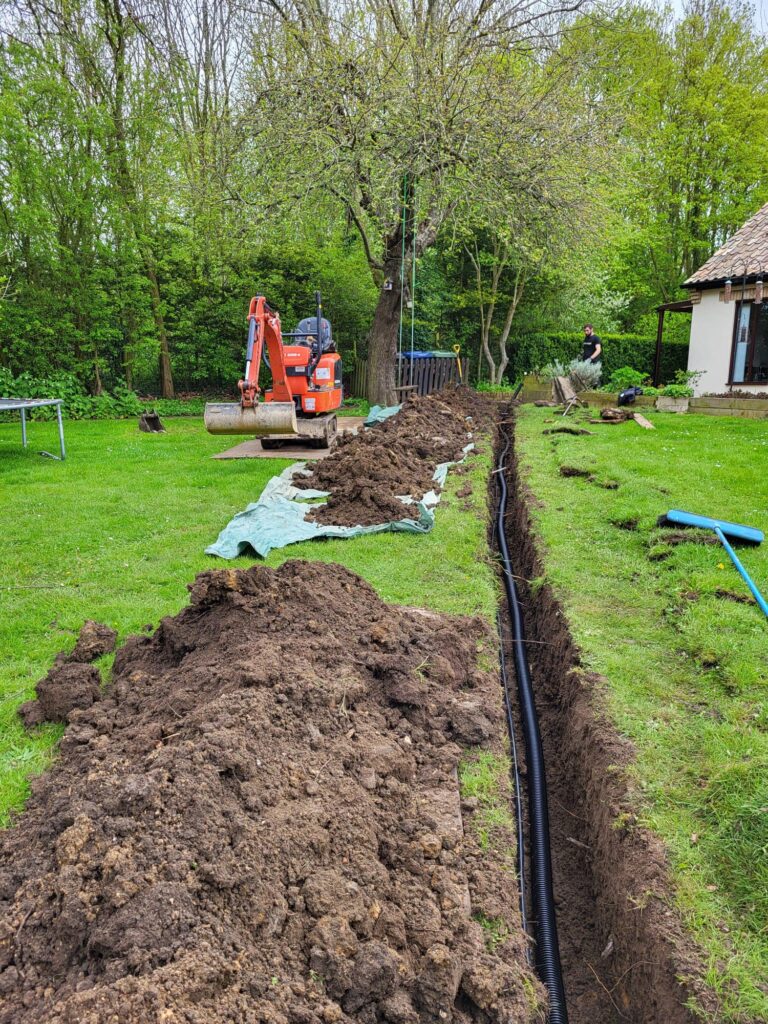
A narrow trench across a lawn
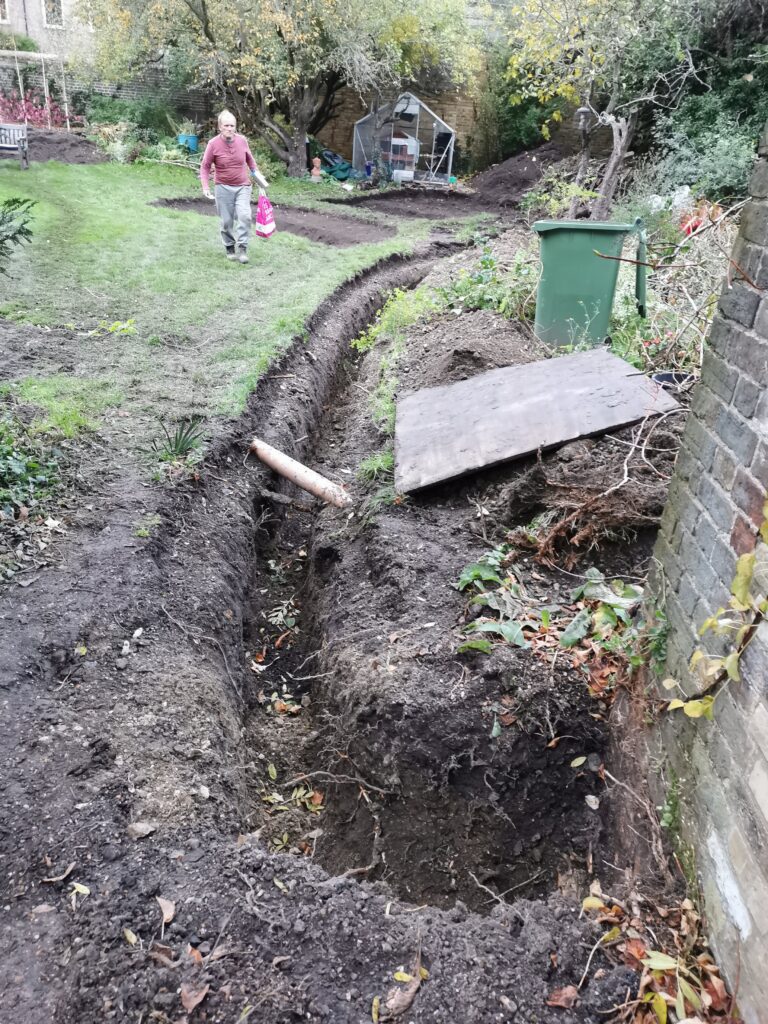
A deep trench beside a wall
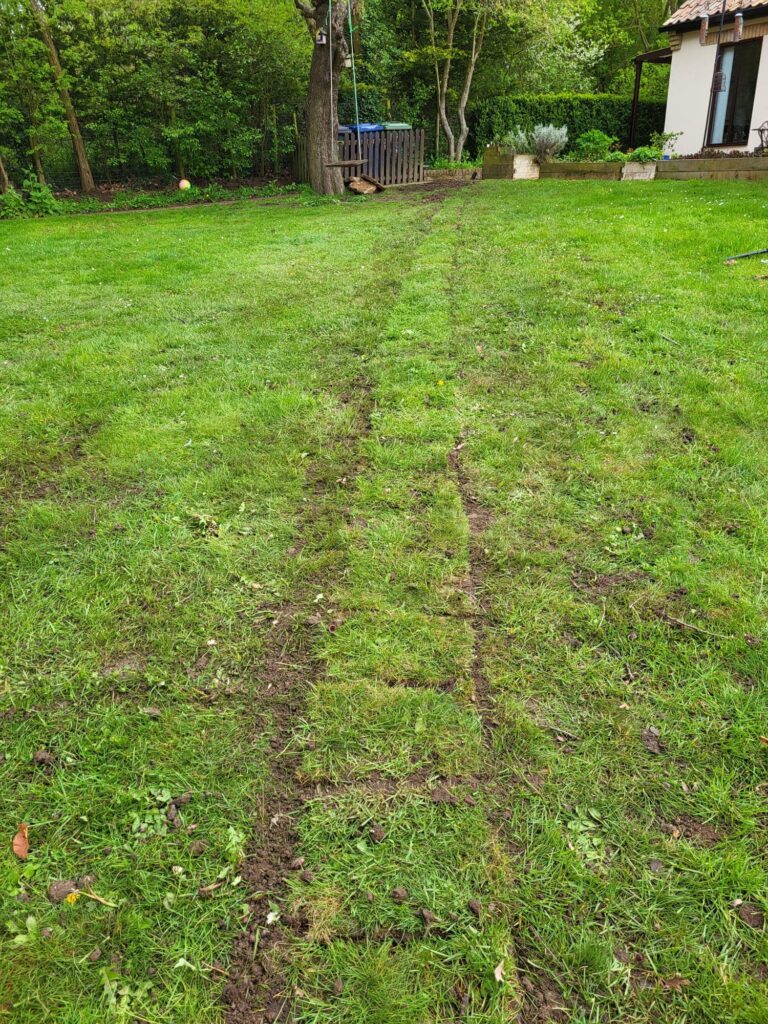
The same lawn, backfilled
Trenches from recent jobs. The same buckets dig French drains and soakaways. See more in my portfolio.
Before you dig a soakaway
- Keep it at least 5 metres from the house, so the water isn’t soaking in next to the foundations.
- Check the ground will take the water. Clay drains slowly, and a percolation test tells you how big the soakaway needs to be, or whether it will work at all, before you dig a big pit.
- Roof water has rules. Soakaways for rainwater from a roof need to be designed to the Building Regulations (Approved Document H). If it’s for a new extension, ask your builder or building control.
- Know where your services run. Water pipes and cables often cross gardens. Mark what you know before the day.
Plan for the spoil
Drains and soakaways produce more soil than most people expect, because gravel and crates take its place. Plan on a skip, a grab lorry or bulk bags. I’m on the digger all day, so I can’t take waste away myself, but I’ll help you choose the right option. My waste disposal page has the details.
What a customer said
“Rob did a fantastic job digging out for our soakaway. He’s very experienced and knows exactly what he’s doing… I really didn’t think installing a soakaway would become such an enjoyable experience!”
Paul S.
Often done alongside
- Garden levelling: water collects in the low spots, so levelling helps too
- Turf preparation: a new lawn on ground that drains
- Trenching for cables, pipes and heat pumps
- Garden clearance: overgrown gardens dug out, roots and all
Got a garden that won’t drain?
Send me photos of where the water sits, ideally taken after rain, plus your access. I’ll get back to you with a quote.
Garden drainage FAQs
Do I need a French drain or a soakaway?
Often both. A French drain collects the water and moves it, and a soakaway gives it somewhere to go. If there’s a ditch or another suitable outfall, a French drain can run to that instead.
How far from the house should a soakaway be?
At least 5 metres from the house and its foundations.
Will a soakaway work in clay?
Not always. Clay drains slowly, so a soakaway in clay needs to be bigger, and in very heavy clay it may not work. A percolation test tells you before you commit.
My new-build garden is waterlogged. Isn’t that the builder’s problem?
Partly. If your home has an NHBC warranty, the ground within 3 metres of the house shouldn’t be waterlogged, so raise that with your builder first. Further out, it’s usually down to you.
When’s the best time to do it?
Take your photos when it’s wet, so I can see where the water sits. The digging itself goes best when the ground isn’t saturated, and I’ll tell you if it’s too wet to work.
Will the digger fit through my gate?
Almost certainly. The mini digger is 70cm wide, so it fits through most garden gates and side entrances. I board out lawns to protect them, too. Here’s what to expect on the day.
How do I get a quote?
Fill in the form below with photos of the wet area and your access, and I’ll get back to you with a quote.
I cover Cambridgeshire, Hertfordshire and Bedfordshire.
Let's chat! Get in touch to discuss your mini digger project
When you submit the form, it will redirect to a "thank you" page. If you don't see this or if you have trouble submitting the form, please WhatsApp me on 07753 911329 instead (and tell me that the form isn't working!). Thanks!


